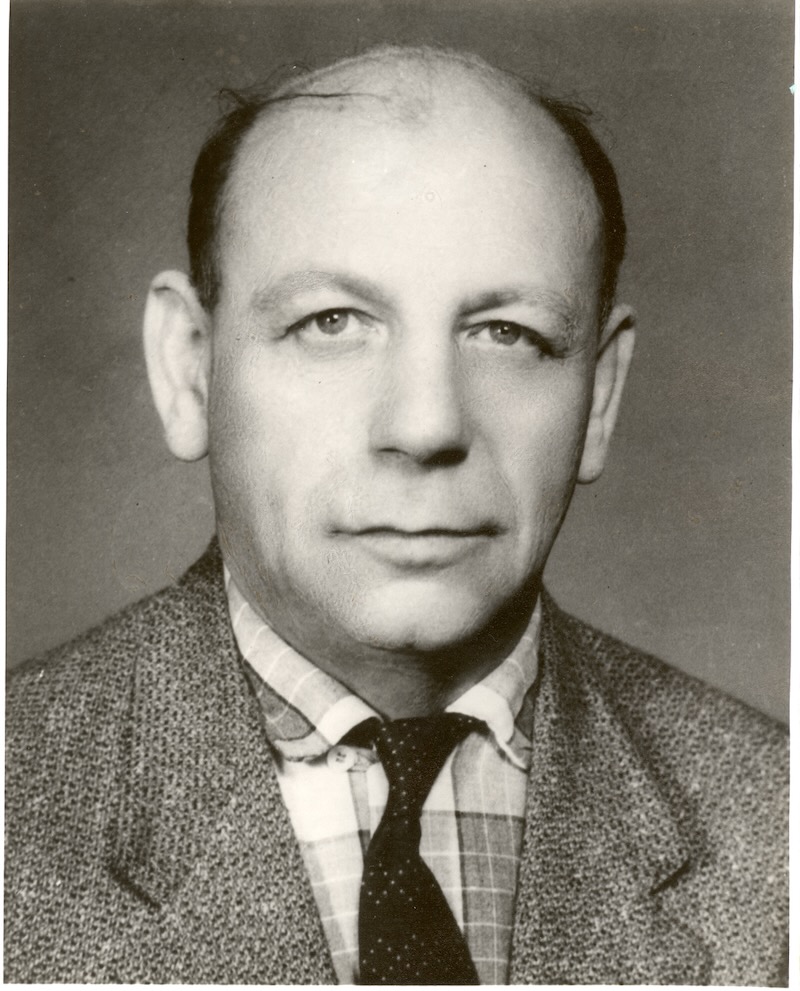
 Oskar Strawczynski, 1964
Introduction
This site serves to memorialize Oskar Strawczynski and to publish his memoirs of his time in Treblinka in the original Yiddish.
An English translation of Oskar’s memoir may also be found in the volume Escaping Hell in Treblinka published by Yad Vashmem.
Oskar Strawczynski was born in Lodz, Poland, in 1906. He was the third child, the oldest son in a family of seven children. Three sisters and three brothers reached adulthood, and most of them already had families by the time World War II broke out.
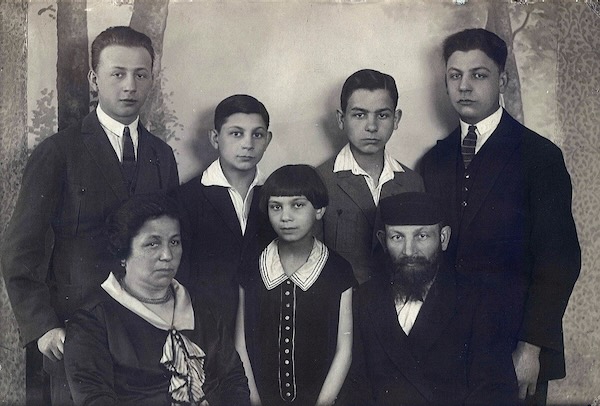
Back row: Left to Right: Zygmunt, Leibl, David, Oskar
Front row: Left to Right: Malka, Nadia, Yoseph
Not Present: Two older married daughters – Sala and Gucia
Only Zygmunt, Oskar and Nadia survived the Shoah.
Educated in a Polish public school as well as a Yiddish cheder in Lodz, Oskar completed his formal education at about age fourteen when he began to work in his father’s tinsmith shop. He was an avid and enthusiastic reader and maintained a special love of Yiddish literature and music throughout his life.
Oskar learned his trade as a tinsmith from his father and became a skilled and accomplished artisan. He took great pride in his work and his services were always in demand. Oskar’s skill as a tinsmith eventually saved his life in Treblinka and also made it possible for him to save the life of his brother Zygmunt.
From 1927 to 1929 Oskar served in the Polish Army. After his mandatory army service, he returned to Lodz and continued his work as a tinsmith. He married Hannah (Anka) Zandberg in 1932.
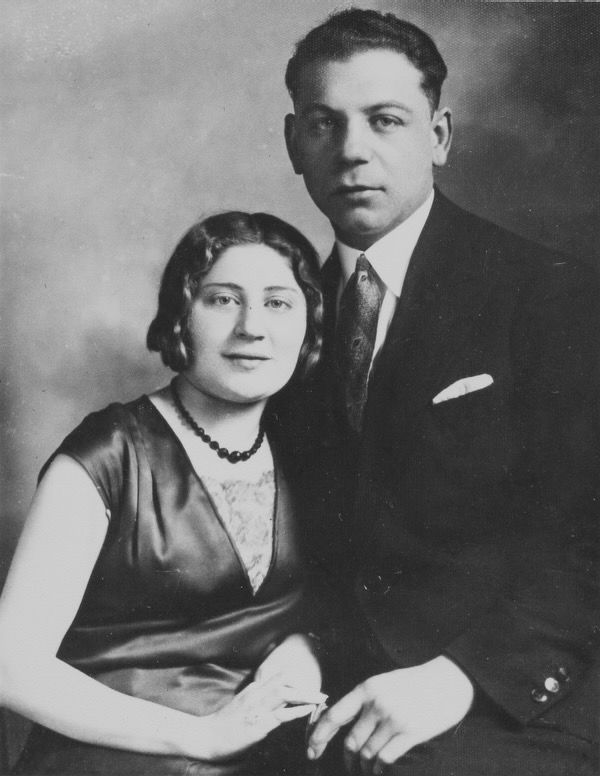
Oskar and his wife Hannah (Anka) shortly after their marriage in 1932.
Their daughter, Guta was born in 1933 and their son, Abus in 1938. Oskar was a very devoted family man who adored his wife and children and had a great love for the other members of his family.
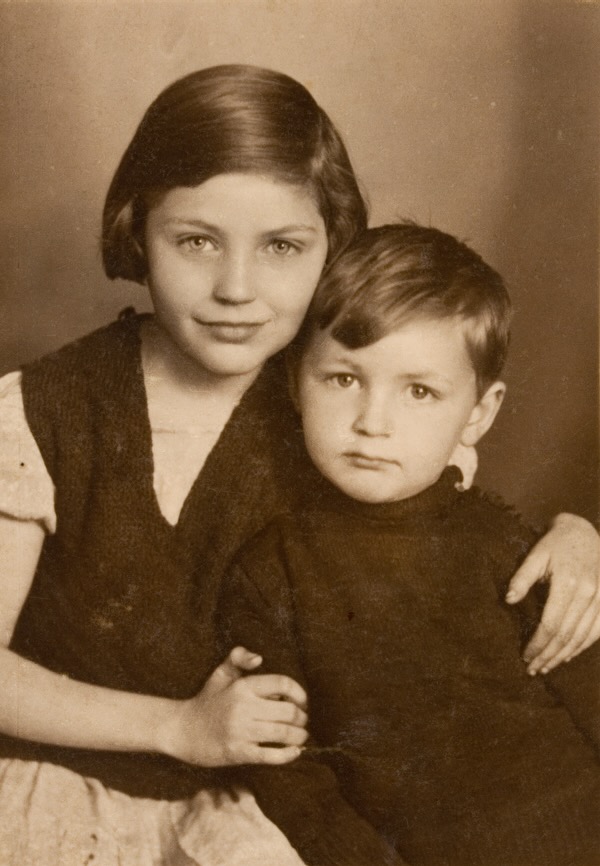
The children of Oskar Strawczynski, Guta(left) and Abus, in 1942. Murdered in Treblinka on October 5, 1942.
His bond with his brother Zygmunt, two years younger than him, was particularly strong.
At the outbreak of the War, Oskar’s wife and children moved from Lodz to Czestochowa where Anka’s family lived to be closer to her family. Oskar remained in Lodz until 1940 when he closed his tinsmith shop. He and his parents, Yoseph and Malka, then moved to Czestochowa where Oskar reopened his tinsmith shop. The entire family was deported to the Treblinka death camp in October 1942.
Oskar’s memoir describes the events from the time of their arrival in Treblinka on October 5, 1942 to the uprising on August 2, 1943. The memoir ends abruptly the day of the uprising in Treblinka, with Oskar, Zygmunt, and a group of prisoners fleeing to hide in the forest surrounding the camp. The brothers hid together until dusk, side by side, fearful of losing each other. When night fell, they entered deeper into the woods. The other prisoners had disappeared. In the darkness, they could see the fires of Treblinka burning and knew that they had to move farther away. As they began to edge through the woods Oskar was grabbed and taken prisoner by armed Poles. Zygmunt, who was not caught, approached the Poles and tried to bargain with them to set Oskar free. The Poles refused and wanted to take Oskar into town to turn him over to the Germans. Zygmunt called to Oskar to ‘run away’. Oskar managed to free himself, struck the Pole holding him, and ran. The Poles began to shoot. Unable to see or call to each other in the dark, the brothers were separated, each thinking the other dead.
Without a map and not knowing the area, Oskar hid during the day and wandered aimlessly in the forest for three nights. Realizing he wasn’t getting anywhere, Oskar decided to move during daylight and began to walk in the middle of the road. He asked the Poles he met for directions to Warsaw, where he and Zygmunt had been planning to go. Everyone who saw him recognized that he was an escaped prisoner, a Jew from Treblinka. He was in mortal danger of being reported to the authorities.
Near the village of Jasiorowka, Oskar stopped a woman and asked where one could buy some bread. It had been three days since he had any food. The woman, Stanislawa Rogoszewska, immediately recognized that he was from Treblinka. She brought him into her house, gave him food to eat and told him to go out and hide in the woods and return to her house that night. She told Oskar that she would introduce him to other Jews who were also hiding in the woods. At night, as promised, she introduced him to several young Jews from Jasiorowka who were hiding in the area and knew it well. Among them was Mottel Cyranko, a 13-year-old boy, who would later introduce Oskar to his second wife.
Stanislawa Rogoszewska was honoured as a “Righteous Among the Nations” by Yad Vashem in 1994.
Oskar spent two months hiding in the Wyszkow woods with the group. He then joined a unit of about a dozen Jewish partisans from the Zydowska Organizacja Bojowa (ZOB, the organization of Jewish fighters), survivors of the Warsaw Ghetto Uprising. Hiding in the forest and moving frequently, the unit was armed and active, laying mines and cutting telephone lines. Gabrysh Fryshdorf, one of the partisan leaders, encouraged Oskar to write an account of his experiences in Treblinka and obtained writing material for him from a nearby village. Fryshdorf wanted to ensure that an eyewitness account of the events at Treblinka was preserved for history.
The memoir was written between October 1943 and April 1944. Hannah Fryshdorf, the wife of Gabrysh, made two copies of the manuscript. The original was lost or destroyed. One of the copies was taken to Warsaw, but as noted by Jacob Celemenski(1), this copy, together with other archival material collected by the Bund, was destroyed in a bunker in Warsaw during the Polish Uprising in 1944. The one surviving copy was placed by Hannah Fryshdorf in the archives of the YIVO Institute for Jewish Research in New York.
Oskar’s memoir is an unusual document. It was written immediately following the revolt in Treblinka, in isolation in the forest, free of pressure and outside influences, when memories were fresh and vivid and survival itself still uncertain. As related by Celemenski, the ZOB partisans
“…told me about an escapee from Treblinka, who had told them of the kind of horrors that the hardened ghetto fighters, who experienced their own hardships, had not seen or heard the like of before. The man had written everything down.
‘Celek,’ Gabrysh said, ‘you must hide this notebook somewhere. It’s one of the most terrifying documents of our time.’” 1
Several members of the ZOB unit, including Gabrysh, were killed in the forest by German patrols and hostile Poles. Oskar and the surviving partisans were liberated by the Red Army in the summer of 1944. Oskar moved to Wegrow, where he found some friends who had survived. There he rented a room and began to work again as a tinsmith. In January 1945, Warsaw and Lodz were liberated. Zygmunt, who had escaped from the forest and eventually reached Warsaw, was reunited with his brother in Wegrow and together they returned to Lodz, their hometown. Zygmunt, blonde and blue-eyed, able to speak excellent Polish without a Yiddish accent, had passed as a Pole. He survived the Warsaw Uprising of 1944 and saw action with the Polish resistance on the outskirts of the city.
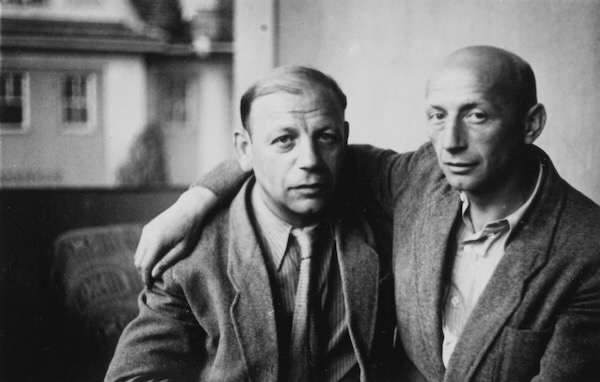
Oskar and Zygmunt (1945 or 1946)
After the liberation, Mottel Cyranko and a few of his surviving family members, including his cousin, Celina Cyranko, emerged from the forests and hiding to return to their village, Jasiorowka. Both Mottel’s and Celina’s parents and siblings had perished during the Holocaust, most in Treblinka in September 1942. In January1945, the night after the Red Army advanced from the village to launch the final offensive against Nazi Germany, Mottel and his family were attacked by members of the Polish resistance. Three were killed. Ironically, this is the same village where Stanislawa Rogoszewska saved Oskar after the revolt in Treblinka. Mottel, Celina and other surviving members of his family fled the village to the city of Lodz, where Mottel knew Oskar was staying and would help them. This is how Oskar met Celina, his future wife.
In August 1946, violent anti-Semitism in Poland forced Oskar and Celina (who was nine months pregnant) to abandon Lodz. They were smuggled into Germany and became displaced persons. In April 1948, Oskar, Celina and their infant son emigrated to Canada and settled in Montreal.
Oskar’s immediate family perished during the war with the exception of his brother Zygmunt, and his youngest sister, Nadia. The surviving family all settled in Montreal and lived there together, literally, first in a single flat, and then as the family’s economic conditions improved, in a triplex: Zygmunt and his family on the ground floor, Nadia and her family on the middle floor and Oskar, Celina and their three children on the top floor.
In Canada, Oskar worked as a tinsmith and sheet metal worker. He worked long hours in a physically demanding trade to support his family. Oskar was a loving and caring husband and father wholly devoted to his family.
In 1964-65, Oskar testified at the war crimes trial of ten Treblinka guards and officials in Dusseldorf, West Germany. When he returned to Canada he was interviewed by CBC Radio and asked why he had decided to testify at the trial. He answered:
I felt it is my duty to my family which perished in Treblinka to come and tell what I had seen there…They [the victims of the Holocaust] should not be forgotten. The price was too high … We cannot revive our dead beloved ones, but we should do everything possible that such a thing will not repeat itself, that it shouldn’t come again, such horrors.2
The most one can ask of a man is that he behave with decency, dignity and courage when confronted with a terrifying and impossible situation.
From the testimony of Samuel Rajzman another survivor of Treblinka:
Oskar Strawczynski’s behaviour in Treblinka was beautiful. He was one of the finest people there. He worked in a shop, and he was allowed to go into this shop at night. There were dozens of sick people among the prisoners. They were dying because they lacked warm liquids. So Oskar Strawczynski used to sit in his workshop and make tea all the time and bring it to the prisoners. Whole nights he used to sit there and make tea for those sick people. If they would have caught him doing that, he would really have had quite a time of it, but he continued to do it all the time he was in Treblinka. He was among those we trusted most in the camp. He was extraordinary. He pulled me through the typhus disease.3
Oskar Strawczynski died on October 29, 1966 after a short illness. We miss him still.
The Family of Oskar Strawczynski
February 2007
-
From Elegy for My People Memoirs of an underground courier of the Jewish Labor Bund in Nazi-occupied Poland 1939-45 by Jacob Celemenski A translation of his “Mitn Farshnitenem Folk “” Published in Yiddish by Farlag Unser Tsait, New York 1963 Published in Melbourne, Australia, 2000 by the J. Celemenski Memorial Trust in Melbourne ↩
-
ibid. ↩
-
From Voices of the Holocaust by Howard Roiter, The testimony of Samuel Rajzman, Chapter 5: The Long Road Out of Treblinka, page 156, Asurno Press, Givataim, Israel / 1975. Samuel Rajzman delivered the eulogy at Oskar’s funeral. ↩